Credo Technology Group: Driving the Future of High-Speed Connectivity
How an Under-the-Radar Innovator Became a Market Leader in Data Center Solutions

Introduction
Data centers are evolving at a rapid pace, driven by the relentless demands of cloud computing, AI workloads, and data-intensive applications. As the volume of data grows, so does the need for faster, more efficient, and more reliable connectivity. Enter Credo Technology Group, a company founded in 2008 with a mission to break bandwidth barriers using innovative, low-power solutions.
In this article, we’ll explore Credo’s journey from a relatively unknown semiconductor startup to a recognized leader in high-speed connectivity solutions. We’ll look at the historical context of the company’s founding, the challenges it faced, how it addressed market concerns, and where it’s headed in a world hungry for ever-greater bandwidth.
1. Historical Context
1.1 Founding Story
Credo Technology Group was established in 2008, a period marked by the rise of cloud computing and the early stages of the hyperscale data center boom. From its inception, Credo focused on delivering high-speed, low-power connectivity solutions for enterprise and hyperscale data centers. By honing in on the balance between analog and digital signal processing—and later leveraging an “N-1” process technology approach—Credo positioned itself to challenge larger, more established incumbents in the semiconductor industry.
1.2 Early Challenges
Breaking into a market dominated by giants like Broadcom and Marvell was no small feat. Credo faced questions about whether its new technologies could overcome entrenched industry standards and established vendor relationships. Customer concentration was also a risk, as the company’s early revenue relied heavily on a few major hyperscalers.
Nevertheless, the accelerating need for faster data center connections—spurred by new AI models, edge computing demands, and the proliferation of cloud services—provided Credo an opening. The company introduced Active Electrical Cables (AECs), SerDes IP, and Optical DSPs to serve bandwidth-intensive applications at 100G, 200G, 400G, and even 800G speeds.
1.3 Key Innovations
Credo’s innovation stems from a careful blend of analog and digital signal processing, along with its N-1 strategy, which uses slightly older but proven process technology nodes. This approach has delivered tangible benefits:
Cost Advantages: Mature nodes help keep manufacturing costs down.
Power Efficiency: Lower power consumption compared to competing solutions.
Scalability: Credo’s product lines adapt to multiple speed grades, from 50G to 800G and beyond.
2. Evolution of the Narrative
2.1 From Newcomer to Market Leader
Credo’s path to market leadership was marked by strategic moves, including focusing on the needs of top-tier hyperscalers. As data centers transitioned from 10G and 25G links to 100G and beyond, Credo’s products became increasingly relevant. The company’s AECs, in particular, gained traction for short-to-medium distances, where they demonstrated reliability, cost savings, and lower power consumption compared to optical solutions.
2.2 Signposts of Growth
Early Wins: Credo secured key design wins among cloud giants, validating its technology.
Product Diversification: The expansion into 112G PAM4 SerDes and PCIe Gen 6 retimers underscored Credo’s engineering excellence.
Market Recognition: Over time, skepticism about Active Electrical Cables subsided, and AECs became widely accepted, especially in AI back-end networks where reliability and cost are paramount.
3. Addressing Past Concerns
3.1 Dependency on Key Customers
Historically, Amazon accounted for an outsized share of Credo’s revenue, leading to concerns about customer dependency. However, Credo has diversified its customer base over the years. In F2Q25, Amazon accounted for 33% of revenue, down from 52% in the prior quarter, while new contributors, including Microsoft and an emerging hyperscaler (believed to be xAI), have collectively reduced single-customer risk.
3.2 Market Acceptance of AECs
When Credo first introduced AECs, critics questioned whether they could compete with entrenched optical cables. But AECs proved their mettle by delivering comparable or superior performance at lower power and cost—particularly for short-to-medium distances and in AI back-end networks. They also alleviated reliability issues such as “link flaps” (brief link disruptions), which can be disruptive and costly in large-scale AI training. Over time, AECs became the de facto standard for 50G+ connectivity, affirming Credo’s strategy.
Management’s consistent focus on AEC technology as a transformative solution has been validated by increasing attach rates per XPU and adoption by all major hyperscalers. The launch of its 800G ZeroFlap AECs, specifically designed for AI backend networks, reflects Credo’s ability to stay ahead of market trends. The narrative has shifted from doubt to recognition of AECs as a key enabler of high-speed data center connectivity.
3.3 Competitive Landscape
Facing larger incumbents, Credo has consistently emphasized product innovation and engineering excellence. Its 112G PAM4 SerDes designs, 800G ZeroFlap AECs, and PCIe Gen 6 retimers address evolving data center requirements for higher bandwidth, lower latency, and greater reliability. Coupled with a cost advantage derived from its N-1 strategy, Credo remains highly competitive.
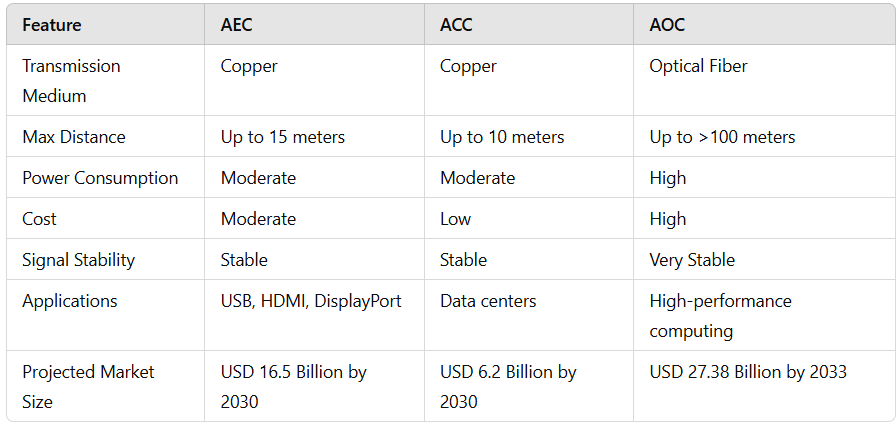
3.4 Comparison of AEC, ACC, and AOC Cable Technologies with Market Insights
Active cable technologies—Active Electrical Cables (AEC), Active Copper Cables (ACC), and Active Optical Cables (AOC)—each serve unique roles in data transmission. Below is a detailed comparison including their origins, use cases, advantages, drawbacks, and market insights.
1. Active Electrical Cables (AEC)
Origin: Developed to enhance traditional electrical cabling by integrating active components to improve signal integrity over longer distances.
Use Case: Commonly used in consumer electronics for connections like HDMI and USB, allowing devices to be positioned farther apart without losing signal quality.
Advantages:
Cost-Effective: Generally less expensive than AOCs.
Lower Power Consumption: More efficient than other active technologies.
Flexibility: Easier to install compared to fiber optics.
Drawbacks:
Limited Distance: Effective for distances up to 15 meters.
EMI Susceptibility: Prone to electromagnetic interference.
Market Insights:
The AEC market is projected to grow from USD 8.9 billion in 2023 to USD 16.5 billion by 2030, at a CAGR of 10.20%.
2. Active Copper Cables (ACC)
Origin: Evolved from traditional copper cabling by incorporating active electronics to boost signal quality and extend transmission range.
Use Case: Predominantly used in data centers and high-performance computing environments for connecting servers and switches.
Advantages:
Cost Efficiency: More affordable than optical solutions for short distances.
Signal Amplification: Enhanced stability due to integrated redriver chips.
Drawbacks:
Distance Limitations: Typically effective for distances up to 10 meters.
Higher Power Consumption: More power-intensive than passive copper cables.
Market Insights:
The ACC market was valued at approximately USD 3.4 billion in 2023 and is projected to reach USD 6.2 billion by 2030, with a CAGR of around 13.2%.
3. Active Optical Cables (AOC)
Origin: Developed to utilize fiber optics for high-speed data transmission over longer distances with minimal signal loss.
Use Case: Ideal for high-bandwidth applications such as data center interconnects and video streaming where long-distance connections are critical.
Advantages:
Long Distance Capability: Can transmit data over distances exceeding 100 meters.
EMI Immunity: Not affected by electromagnetic interference.
High Data Rates: Supports speeds up to and beyond 400 Gbps.
Drawbacks:
Higher Cost: Generally more expensive due to complex optical components.
Power Consumption: Requires more power for optical-electrical conversion.
Market Insights:
The AOC market is expected to grow significantly, with projections estimating a market size of USD 27.38 billion by 2033 at a CAGR of approximately 14.2%.
Summary Table
Customer Success Stories
Credo’s transformation into a cornerstone of AI infrastructure is exemplified by its customer success stories:
Microsoft’s AI Revolution: Microsoft’s AI infrastructure team faced reliability issues in their early large language model training clusters. Link flaps caused training runs to fail after days of computation. After switching to Credo’s 800G ZeroFlap AECs, Microsoft achieved a 99.999% reduction in connection-related training failures, a 15% improvement in overall cluster efficiency, and a 40% reduction in networking-related power consumption.
Amazon’s Efficiency Leap: Amazon’s adoption of Credo’s AECs improved data center efficiency, enabling seamless scalability for its AI training clusters. The advanced signal processing and thermal management of Credo’s solutions played a pivotal role in Amazon’s ability to handle growing workloads while reducing costs.
Oracle’s AI Infrastructure: Oracle’s next-generation AI infrastructure relied on Credo’s custom high-density interconnect systems, reducing rack-to-rack connection costs by 35% and enabling a 50% increase in compute density. These improvements provided Oracle with a significant competitive advantage in the cloud market.
4. Exploiting Current and Future Opportunities
4.1 Hyperscaler Adoption
Over the past decade, hyperscalers such as Amazon, Microsoft, and Google have evolved from large cloud providers into massive technology ecosystems, with data center investments that dwarf those of traditional enterprises. These investments span everything from compute and storage to networking infrastructure, and Credo has successfully positioned itself to meet hyperscalers’ growing appetite for high-speed connectivity.
Partnerships and Design Wins: Credo’s focus on developing reliable, energy-efficient connectivity solutions has made it an attractive partner. Its products—especially Active Electrical Cables (AECs)—are now fundamental components in short-to-medium distance interconnects within hyperscale environments. This traction has boosted Credo’s revenue and established its reputation as a credible, go-to vendor.
Emerging Players: While Amazon and Microsoft remain key clients, newer hyperscalers like xAI (and other AI-focused initiatives) represent additional engines of growth. These emerging providers are building state-of-the-art data centers optimized for machine learning and advanced analytics. By securing early design wins with these next-generation hyperscalers, Credo expands its customer base and mitigates the concentration risks historically associated with a few large clients.
Strategic Value: Being embedded in hyperscaler networks gives Credo direct insight into next-generation technology requirements. Hyperscalers often lead the way in scaling up bandwidth, adopting novel data center topologies, and testing new cooling technologies. By working closely with these pioneers, Credo gains real-time feedback that informs its product roadmap, ensuring that subsequent solutions stay ahead of market demands.
4.2 AI-Driven Growth
The ascendancy of AI has fundamentally reshaped data center requirements, with a particular emphasis on high-bandwidth, low-latency interconnects. Training massive AI models involves continuous data shuttling among compute, storage, and memory resources—any disruption or bottleneck can lead to costly downtime or suboptimal performance.
High-Bandwidth Imperatives: As AI models grow in complexity (think GPT-scale or larger), the data center infrastructure must keep pace. Credo’s solutions, ranging from 100G to 800G and beyond, are designed to handle these bandwidth-intensive demands. This is especially critical when orchestrating thousands of GPUs or specialized AI accelerators in parallel.
Mitigating “Link Flaps”: A common challenge in AI clusters is the “link flap,” an intermittent connectivity issue that causes disruptions. Credo’s 800G ZeroFlap AECs tackle this problem head-on by stabilizing the links, significantly reducing error rates and jitter. For hyperscalers and AI startups alike, stable networking can drastically shorten AI training times, reduce operational headaches, and lower overall total cost of ownership (TCO).
Indispensable for Large-Scale AI: When data center operators invest in massive AI training clusters, they prioritize both performance and reliability. Credo’s ability to deliver on both fronts—with a solid track record of customer wins—positions the company as an essential hardware partner for AI-driven organizations. This AI-centric market is poised for exponential growth, and Credo’s products are right at the heart of it.
4.3 New Market Segments
While high-speed Ethernet interconnects remain a cornerstone of Credo’s business, the company is strategically broadening its reach into PCIe (Peripheral Component Interconnect Express) and CXL (Compute Express Link) to address new and emerging data center architectures.
Rationale for Diversification: Modern data centers are not just about Ethernet links; they also depend heavily on high-speed interconnects at the server and rack level. PCIe has long been the backbone for connecting CPUs, GPUs, SSDs, and other accelerators within a system. With the rise of disaggregated and composable architectures—where memory and storage may be pooled and shared across multiple compute nodes—connectivity demands are intensifying in PCIe backplanes.
Low-Latency Connectivity: As data travels between components at ever-higher speeds, small inefficiencies can accumulate into significant bottlenecks. PCIe and CXL retimers help maintain signal integrity and reduce latency, making them key enablers in next-generation architectures that blend memory, compute, and storage in more fluid ways.
Forward-Looking 1.6T Solutions: Credo’s plans for 1.6T connectivity underscore its commitment to staying ahead of the performance curve. While 800G solutions are becoming mainstream in AI clusters, 1.6T will address the next wave of data center demands, including exascale computing and advanced HPC (High-Performance Computing) workloads. If Credo’s track record in AECs and SerDes is any indication, the company could become a leading provider of 1.6T solutions, capturing significant market share as data center operators leapfrog existing standards.
Holistic Approach: By spanning Ethernet, PCIe, and CXL, Credo aims to be more than just an interconnect vendor—it strives to be an end-to-end connectivity partner for data centers. This multi-pronged approach also provides a hedge against shifting standards. Should AI architectures tilt more heavily toward specialized fabrics or if memory disaggregation via CXL becomes the norm, Credo can adapt without pivoting away from its core competencies.
In sum, Credo’s opportunity landscape extends well beyond its initial markets, with hyperscalers, AI workloads, and evolving data center topologies all fueling its growth. Whether it’s cementing relationships with cloud giants, solving critical connectivity pain points in AI clusters, or staking an early claim in PCIe and CXL for future 1.6T networks, Credo is positioning itself as a comprehensive provider of next-generation connectivity solutions.
5. Present Performance and Financial Outlook
5.1 Revenue Trajectory
Credo’s financial performance underscores its momentum:
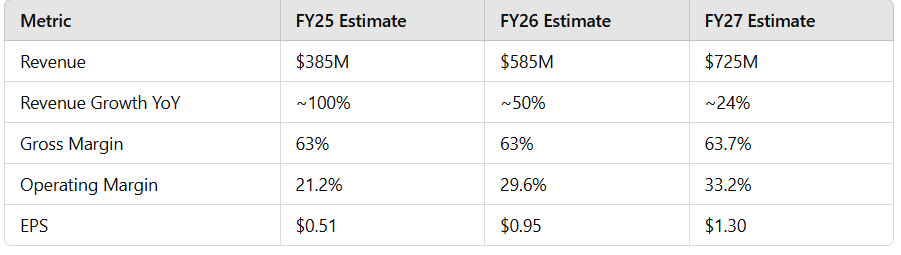
FY25 Revenue: Projected at $385M, representing nearly 100% year-over-year growth.
FY26 Revenue: Anticipated to reach $585M, a 50% increase from FY25.
5.2 Market Size and TAM
The total addressable market (TAM) for high-speed connectivity is expected to grow sharply, fueled by the rapid expansion of AI, cloud computing, and hyperscale data centers. Credo estimates that its key segments—covering high-speed interconnects and related solutions—could reach a $5 billion TAM by 2025, with a 36% CAGR. Within this market, AECs represent a substantial and fast-growing slice, buoyed by accelerating adoption in AI-centric environments.
5.3 Product Mix and Margins
Credo’s product mix is evolving in a way that supports strong margin growth:
Gross Margins: Projected to reach 63% by FY26, reflecting the higher-value nature of AECs and advanced connectivity solutions.
Operating Margins: Forecasted to climb to 29.6% in FY26, demonstrating scalability and operating leverage.
EPS: Estimated at $0.51 in FY25, rising to $0.95 in FY26 and $1.30 by FY27.
6. Technology Roadmap and Industry Trends
6.1 AEC Dominance
AECs have evolved into a cornerstone of Credo’s portfolio, especially the 800G ZeroFlap AECs. These cables are designed to address challenges in next-generation data centers, including liquid-cooled, high-density rack environments. With minimal disruptions and lower power consumption, AECs are increasingly the go-to solution for AI back-end connectivity.
6.2 PCIe and Beyond
Credo’s focus isn’t limited to Ethernet-based solutions. The company has made strategic forays into PCIe and CXL retimers, aiming to support the future of data center memory and storage architectures. As more AI and HPC workflows require higher bandwidth and lower latency, Credo’s PCIe Gen 6 offerings will become integral to leading-edge compute clusters.
6.3 Future Innovations
Data centers are shifting toward coherent optics for intra-data center connections as speeds jump to 1.6T and beyond. Credo’s ongoing R&D efforts will likely yield even more advanced SerDes and AEC capabilities to meet these demands. In parallel, the N-1 strategy ensures the company can innovate without ballooning costs—an attractive proposition for data center operators looking to manage both performance and budget constraints.
7. Investment and Strategic Considerations
7.1 Credo’s Competitive Moats
Innovation Pipeline: The company’s roadmap for 112G, 224G, and future SerDes implementations keeps it ahead of the curve.
Cost Advantage: Leveraging proven process nodes helps reduce manufacturing costs, boosting both competitiveness and margins.
Customer Relationships: Deep ties with hyperscalers ensure sustained demand and grant Credo valuable feedback loops for product refinement.
7.2 Risk Factors
Industry Consolidation: Mergers and acquisitions among larger players could alter the competitive landscape.
Shifting Architectures: A sudden pivot in data center design—such as a move away from certain connectivity standards—could test Credo’s adaptability.
R&D Continuity: Staying at the forefront of high-speed connectivity requires sustained investment in engineering and product development.
7.3 Catalysts for Growth
AI and HPC: The continuous expansion of AI workloads bodes well for 800G and soon 1.6T solutions.
New Hyperscalers: Emerging cloud providers and AI-focused startups (e.g., xAI) represent additional revenue streams.
Connectivity Upgrades: As the industry migrates to liquid-cooled, high-density racks and advanced network topologies, demand for leading-edge solutions will surge.
Conclusion
Credo Technology Group’s rise illustrates how innovation, a strategic focus on real-world data center needs, and smart execution can transform a small player into a market leader. By addressing early concerns—such as heavy reliance on a few hyperscalers—and demonstrating the superiority of Active Electrical Cables, Credo has firmly established itself at the forefront of high-speed connectivity.
As AI workloads proliferate and data centers undergo structural changes—embracing liquid cooling, higher compute densities, and emerging interconnect technologies—Credo remains well-positioned to thrive. Its roadmap for 1.6T solutions, PCIe Gen 6 retimers, and continued enhancements to AECs aligns perfectly with industry trends. Investors and tech enthusiasts alike should keep a close eye on Credo as it continues to shape the future of data center connectivity.
#AI #TechGrowth #DataCenters CRDO 0.00%↑ ANET 0.00%↑ AVGO 0.00%↑ MRVL 0.00%↑ SOXX 0.00%↑ SMH 0.00%↑ NVDA 0.00%↑
thanks for the article. but i would like to ask where did you get this $5B TAM in 2025 from? didnt see them from management prior estimates