The Quality Trap
The case for evolving quality: following the migration of profit pools, not the comfort of spreadsheets

TL;DR:
Traditional quality screens reward companies with great historical metrics — the winners of the last era, not the next.
Value migration is rerouting profit pools from incumbents with moats to challengers investing ahead of the curve.
Real quality today lies in evolving quality: tracking where advantages are forming, not where they once were.
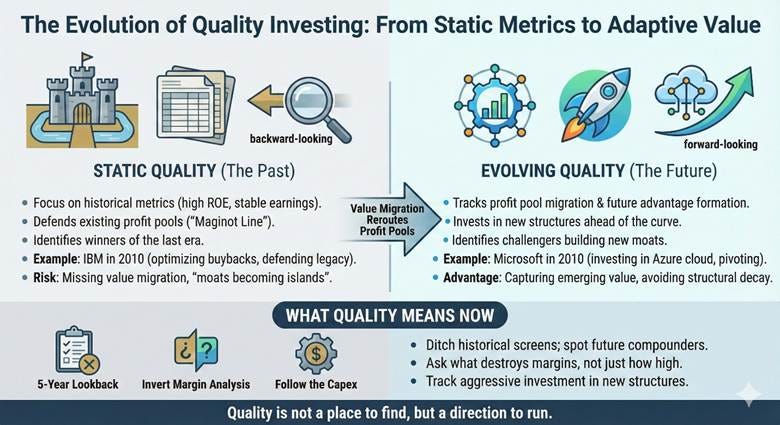
In 2000, a local newspaper was the perfect business. Regional dailies monopolized local advertising; classifieds were rivers of gold. Subscriber churn was minimal, balance sheets clean, cash flows predictable. Run the numbers through any quality screen and newspapers lit up green: high ROE, stable earnings, low leverage, pricing power.
A quality investor following the Munger playbook: buy wonderful businesses at fair prices, hold forever; would have seen exactly what the doctrine promised. Within fifteen years, the industry had lost eighty percent of its value. The internet unbundled the bundle. Classifieds went to Craigslist, display ads followed eyeballs to Google and Facebook.
The numbers had been pristine. They had also been backward-looking. The profit pool was already leaving; the quality metrics simply hadn’t noticed.
This pattern should haunt every investor making the case for “cheap quality” today. The mechanism that killed newspapers — value migration from incumbents to new structures: is playing out right now across sectors that quality screens love.
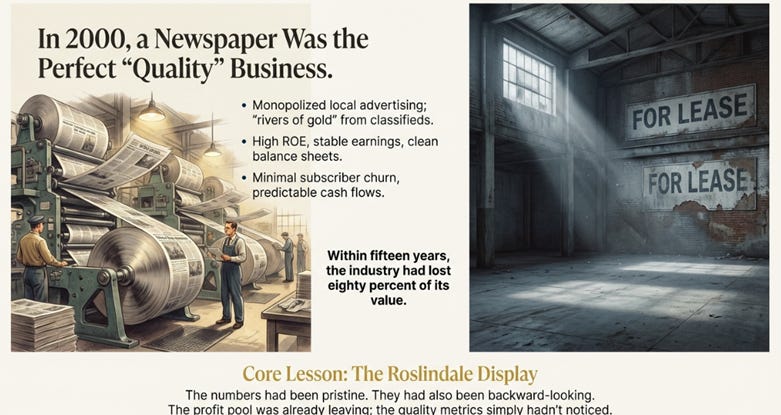
The Maginot Line
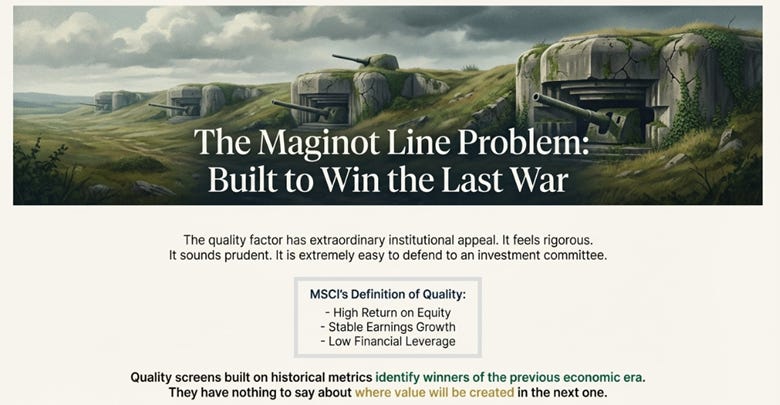
The quality factor has extraordinary institutional appeal, which is precisely the problem. MSCI defines it cleanly: high return on equity, stable earnings growth, low financial leverage. You can screen for it, backtest it, show long-term charts proving quality outperforms. It feels rigorous. It sounds prudent. It is extremely easy to defend to an investment committee.
This is the Maginot Line problem: exquisitely engineered to win the last war. After World War I, France built the most sophisticated static defense in military history. The Germans went around it.
Quality screens built on historical metrics make the same error. They identify winners of the previous economic era. They have nothing to say about where value will be created in the next one.
Consider what this looked like in practice.
IBM vs. Microsoft: A Case Study in Two Qualities
In 2010, IBM was the ultimate quality stock. Return on equity above forty percent. Massive free cash flow. Fortress balance sheet. The company was so confident in its quality that it announced a five-year plan to double earnings per share through buybacks and margin optimization. That year, IBM spent six billion dollars repurchasing its own shares.
Microsoft, by contrast, looked like a mess. The mobile transition had passed it by. Windows was under threat. The company was bleeding money on Bing, flailing with Surface, watching Google and Apple eat its relevance. Analysts questioned whether Microsoft could ever grow again.
Static quality, the backward-looking kind, said buy IBM. It had the numbers, the track record, the margins.
Evolving quality, the kind that tracks where profit pools are migrating, said buy Microsoft. Enterprise software was shifting from licenses to subscriptions. Computing was moving from on-premise to cloud. While IBM was optimizing the past, Microsoft was spending eight billion dollars building Azure. One was defending where value had been. The other was buying a ticket to where it was going.
Today Microsoft is worth over three trillion dollars. IBM is fighting for relevance, having sold off businesses and shrunk its way through a lost decade. The quality metrics in 2010 were not wrong. They were just describing the past.
Static Quality vs. Evolving Quality
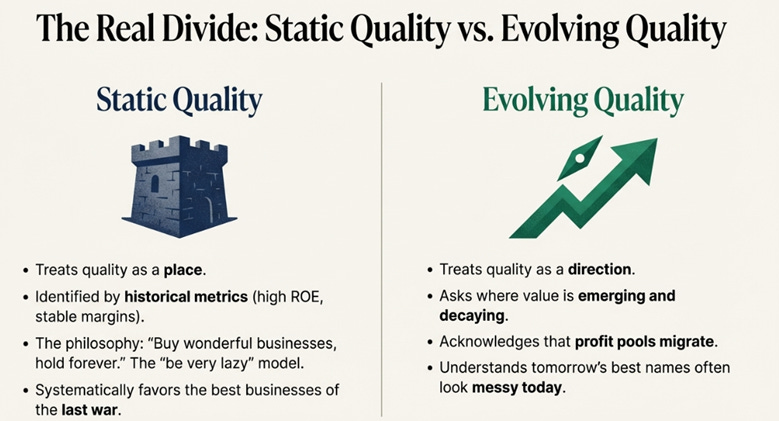
This is the real divide in quality investing. Not quality versus growth, or quality versus value. The divide is between two conceptions of what quality means.
Static quality treats quality as a place. Good businesses can be identified through historical metrics; once you own them, the job is done. Hold, wait, collect returns. This is the Munger model, the quality factor model, the “be very lazy” model.
Evolving quality treats quality as a direction. It asks not just where quality resides today but where it is emerging and where it is decaying. It acknowledges that profit pools migrate: that dominant businesses of one era are often disrupted incumbents of the next.
The tension is sharp. Tomorrow’s best quality names look messy today; their metrics aren’t clean because they’re still building. Today’s statistically perfect names are often past their peak; the numbers look great because they reflect accumulated advantages of a fading structure.
Static quality systematically favors the latter. It is optimized to buy the best businesses of the last war.
Moats Becoming Islands
Warren Buffett’s moat framework has been enormously influential, and for good reason. Durable competitive advantages protect profitability. Moats matter.
But a moat only provides value if people want access to your castle. If the profit pool migrates, your moat doesn’t protect you. It isolates you. You’re no longer a defended fortress. You’re an island nobody visits.
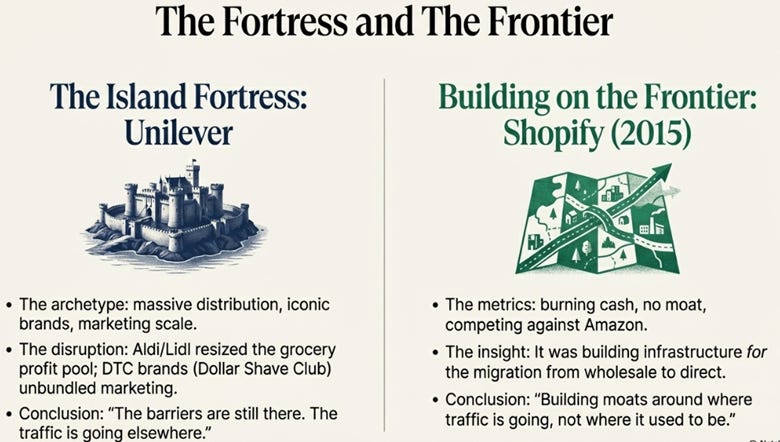
Consider Unilever. For decades, the archetype of quality: massive distribution, iconic brands, marketing scale that smaller players couldn’t match. The moats were real and deep.
They are becoming islands. Aldi and Lidl have permanently resized the grocery profit pool, training consumers that private label is good enough. Direct-to-consumer brands have unbundled the marketing advantage: Dollar Shave Club didn’t need shelf space, it needed a YouTube video. The barriers that protected Unilever are still there. The traffic is going elsewhere.
Now consider Shopify in 2015. The metrics were terrible: burning cash, no moat, competing against Amazon. A quality screen would have dismissed it immediately.
But Shopify was building the infrastructure for the migration itself. As brands moved from wholesale to direct, they needed tools. Shopify provided them. The company wasn’t defending an existing profit pool; it was positioning to capture a new one. Today Shopify powers millions of merchants and has created more value than most of the “quality” retailers whose distribution it helped bypass.
That is evolving quality: building moats around where traffic is going, not where it used to be.
The Mean Reversion Trap
The contemporary case for quality runs like this: quality stocks have underperformed sharply, now trading at a thirty percent discount to the market. Historically, such discounts preceded strong returns. Therefore, buy cheap quality and wait for mean reversion.
This thesis rests on factor analysis, which is agnostic about business fundamentals. It tells you what happened when certain metrics reached certain levels. It doesn’t tell you whether the businesses behind those metrics face stable conditions or structural headwinds.
Look at where “cheap quality” concentrates today. Consumer staples facing permanent margin pressure from discounters and DTC brands. Traditional healthcare being reshaped by telehealth and AI. Old-line industrials watching software eat their service revenues.
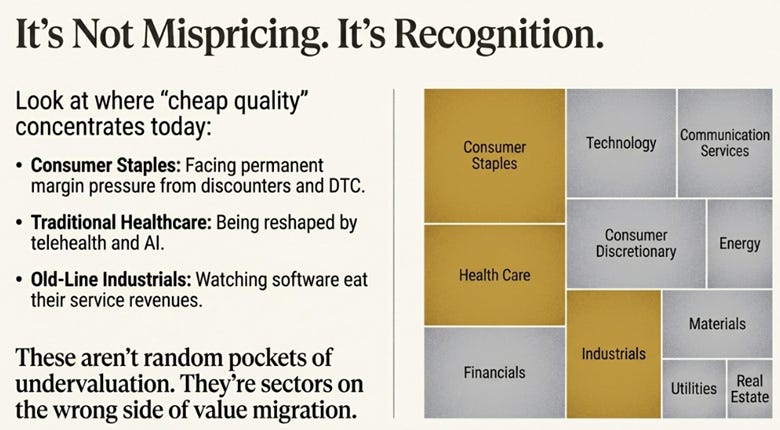
These aren’t random pockets of undervaluation. They’re sectors on the wrong side of value migration. The cheapness isn’t mispricing. It’s recognition.
There’s also an implicit bet that quality investors rarely acknowledge. The argument says you don’t need a view on AI, just buy cheap quality and let the bubble sort itself out. But owning cheap incumbents is itself a view. It’s a bet that those incumbents withstand disruption better than challengers. It’s a bet that profit pools stay where they are.
This isn’t neutrality. It’s a bet disguised as prudence.
What Quality Should Mean Now
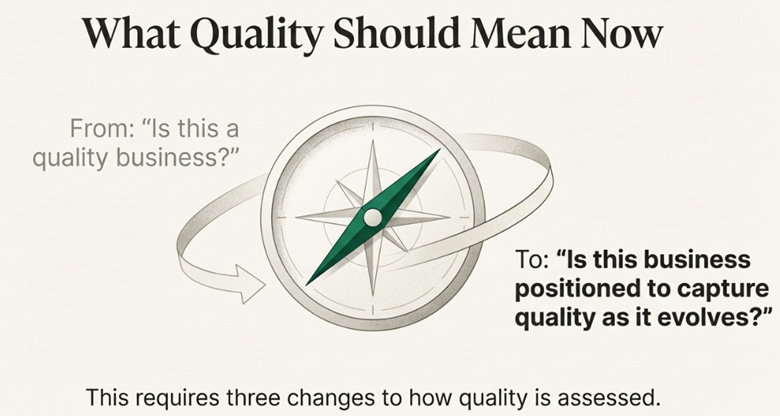
The question for investors is no longer “Is this a quality business?” It’s “Is this business positioned to capture quality as it evolves?”
This requires three changes to how quality is assessed.
· Ditch the five-year lookback. If your screen couldn’t identify Shopify in 2015 or Microsoft in 2010, it isn’t a quality screen. It’s a museum catalog. The job is to identify what will compound, which means tracking where advantages are forming, not where they formed.
· Invert the margin analysis. Don’t ask “How high are the margins?” Ask “What would destroy these margins, and is that force already here?” For newspapers, it was Craigslist. For Nokia, the shift from hardware to ecosystems. For IBM, the move from on-premise to cloud. If you cannot name the margin-destruction vector and explain why it won’t arrive, you don’t understand the position.
· Follow the capex. Profit pools migrate where the smart money builds. If your quality company isn’t investing aggressively to meet the new structure, it’s defending a moat around a dry castle. Microsoft under Nadella poured billions into Azure while IBM optimized for buybacks. The financials in 2013 wouldn’t tell you which was which. The capital allocation would.
The Real Risk
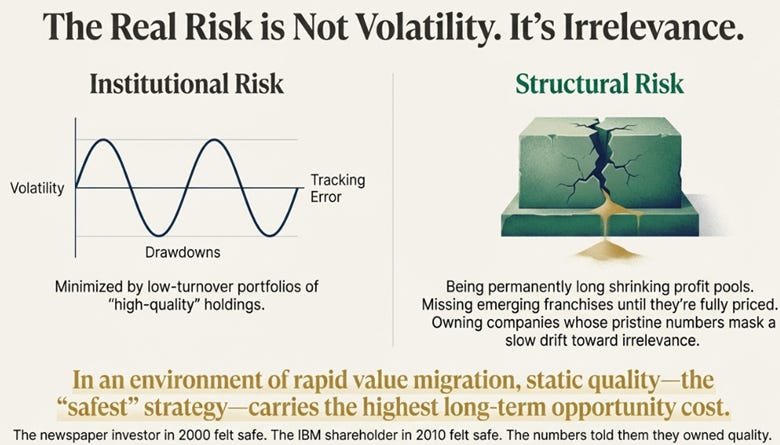
Institutional investors define risk as volatility, drawdowns, tracking error. A portfolio of high-quality holdings with low turnover feels safe because it minimizes these metrics.
But in an environment of rapid value migration, the deeper risk is structural: being permanently long shrinking profit pools, missing emerging franchises until they’re fully priced, owning companies whose pristine numbers mask a slow drift toward irrelevance.
By this definition, static quality — the “safest” strategy — carries the highest long-term opportunity cost. The seemingly risky approach — backing businesses where quality is emerging — becomes the only way to avoid structural decay.
The newspaper investor in 2000 felt safe. The IBM shareholder in 2010 felt safe. The numbers told them they owned quality. The numbers weren’t wrong. They were just describing the past.
From Newspapers to Now
“Be very lazy” was brilliant advice when quality was stable and underappreciated. The Munger playbook wasn’t wrong. It was fitted to a world where competitive advantages eroded slowly and profit pools moved incrementally.
That’s not this world. Quality is not an endpoint to be identified and held. It’s a moving frontier.
The question is no longer quality versus growth or quality versus value. It’s whether you’re buying static quality in yesterday’s profit pools, or evolving quality where tomorrow’s will be.
Quality isn’t a place you find. It’s a direction you run. Right now, it’s running away from the spreadsheets that claim to measure it.